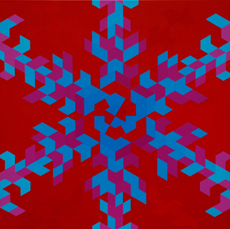
We’re delighted today to be able to showcase the work of Aleksander Drakulic, a Slovenian artist currently living and working in Budapest, Hungary.
Did you study art and if so where?
I work as a graphic designer, and have worked previously as an art director. The last few years I have been working in the field of measurement and testing: time, frequency, environmental and vibration testing systems. Thanks to all, whom I could learn from, for helping me to understand the illusion of time, space and accuracy.
Why do you like Op Art?
I prefer to call it psycho kinetic art . We live in a world that can be both a beautiful illusion and nightmare in our mind. Op Art helps us to understand that the Universe and our perception of the Universe is much more complex than it might seem and that we live within its ever changing patterns of multidimensional space-time-cycles.
Which Op Artists have particularly inspired you?
I have taken inspiration not only from the ‘traditional’ art world but also from studies of Arabic geometry, Plato, Euclid, Pythagoras, modern science and multilevel geometry which I have found to be much more useful in trying to understand the fundamentals of modern thought.
How do you make your art?
Creating artwork is a passion. Pushing geometry to its very limits, making geometry look almost like a part of the material world means you have to use all the tools you have available.
Thanks to Aleksander for getting involved. You can see more of Aleksanders’s work on his website.
Francis Celentano is one of the original Op Art pioneers who was featured in the cutting edge exhibition that is credited with bringing the Op Art movement to the mainstream – the famous “Responsive Eye” exhibition held at New York’s Museum of Modern Art in 1965 – where his work was shown alongside work by Bridget Riley and other key artists of the movement.
Poniard Series
Francis Celentano
1965
acrylic on masonite
34 x 42Image from Elliptical Kinetic Painting III
Francis Celentano
1968
Serigraph print
20×28 framedAlpha Diamond IV
Francis Celentano
1969
acrylic on canvas
57 x 57 diagonal
Francis’s work has been collected by (amongst others) the Museum of Modern Art, the Whitney Museum of Contemporary Art, The Albright-Knox Gallery, The Museum of Contemporary Art in Buenos Aires and The Seattle Art Museum. He is currently represented by the Loretta Howard Gallery in New York and the Laura Russo Gallery in Portland, Oregon.
Red Alternates
Francis Celentano
1969
acrylic on canvas
35 x 48Red Alternates
Francis Celentano
1969
acrylic on canvas
35 x 48Alpha Reverse in Black and White
Francis Celentano
1970
acrylic on canvas
35 x 48
We are absolutely honoured to be able to feature Francis’s work on the site.
Did you study art? If so, where? I took elective courses in drawing and painting in Undergraduate school at New York University. My studies were predominantly in the history of art in graduate and undergraduate school at New York University. In the 1950’s in New York when I started painting I was encouraged by ideas I shared with contemporary artists as well as exhibitions of avant-garde art. A Fulbright gave me a year in Rome in 1957-58 which was also important in the direction my art took.
Diamorphus 10
Francis Celentano
1977
acrylic on plastic
58 x 8Iota 18a
Francis Celentano
1973
acrylic on plastic
60 x 8Exana #10
Francis Celentano
1993
Acrylic on Plastic
60×8
Why do you like Op Art? Because it’s a clearly calibrated means of visual expression. it exists solely on its own terms. The subject is purely perceptual without external references. Each work of art demands attention on every visual level of interaction in terms of itself alone.
How do you make your art? I use Photo Shop to design my paintings and then I scale up the design. I make adjustments, select the colors and transfer the design to canvas or a plastic surface. The piece begins with an idea. I may draw and/or work out solutions before I start working on it in PhotoShop.
Spira P Sycopated
Francis Celentano
1988
acrylic on plastic
67×10Serpa 4
Francis Celentano
2002
acrylic on plastic
60×10Spira R Syncopated
Francis Celentano
1968
acrylic on plastic
67×10
What’s the process for making one of your artworks? There have been many different series over the years. Each painting in a series is done in the same way. For example the recent Gemini series involved the overlapping of two identical patterns. By this means a new pattern with new shapes was generated. I used PhotoShop to design the pattern and manipulate the overlaps choosing those that I felt were exciting. The pattern is scaled up to fit the size of the canvas, printed out, traced onto the canvas and painted with selected acrylic colors.
Le Cirque 10
Francis Celentano
2004
acrylic on canvas
60 x 84Electra 5
Francis Celentano
1990
acrylic on canvas
45 x 60Le Cirque 2
Francis Celentano
2003
acrylic on canvas
44 x 62 inch
Final thoughts?. For me Op Art or Perceptual Art, intriguing for its ambiguities and tensions, seem to function as a metaphor for the distortions of experience and reason generously provided by nature and culture.
Six Radial Spin
Francis Celentano
2008
acrylic on canvas
48 diameterGemini 6
Francis Celentano
2011
acrylic on canvas
34 x 34 inch diagonalTriple Counter Rotation
Francis Celentano
2009
acrylic on plastic
46 inch diameter
You can see more of Francis’s work and read about his fascinating life and artistic career (spanning 5 decades) on his website.
A YouTube video here shows Francis’s Elliptical Kinetic Painting from 1967.
https://www.youtube.com/watch?v=Q6JL-wMVz6c#t=12
“Lavendar Creed” from 1964 – Francis Celentano’s work that was featured in “The Responsive Eye”
Yohei Yama was born in Japan and currently lives and works in France. A component common to the majority of Yohei’s works seen here is the miniature trees – something that came to Yohei whilst in shock after Fukushima, probably the most devastating nuclear accident in the history of mankind. You may not have heard much in the press recently about Fukushima but that doesn’t mean it’s no longer a problem as you can see here.
Energy of the sun
Yohei Yama
91cm x 117cm
acrylic and ink on canvas
2013Like a Travelling Bird
Yohei Yama
100cm x 100cm
acrylic and ink on canvas
2013Energy of the moon
Yohei Yama
91cm x 117cm
acrylic and ink on canvas
2013
“Right after the disaster hit Japan in 2011, I was too shocked and could not work on my paintings for many days. Suddenly a motif of a small tree came into my mind. I don`t know why but the more I drew the motif, the more I got filled with energy and I was able to start again. I realized that the trees are healing for me, for people, for nature which humans have destroyed.“
Did you study art? If so, where? No, I am a self-taught artist. Nature is my teacher.
Circle of life
Yohei Yama
100cm x 100cm
acrylic and ink on canvas
2013Spiral
Yohei Yama
72.7cm x 60.6cm
acrylic and ink on canvas
2013Star
Yohei Yama
91cm x 72.7cm
acrylic and ink on canvas
2013
Why do you like Op Art? Because for me Op Art is so spiritual; I gives me a very good feeling to see this kind of art. Also my eyes like the magical vibration of Op Art.
How do you make your art? I paint with acrylic and pen. I just follow my feelings and inspiration – there’s no calculation involved.
What’s the process for making one of your artworks? First I paint with acrylic to lay down the colour and create the environment; then I plant little trees (my motif) all over the canvas. To plant all these little trees is like a kind of meditation for me.
Any other art you like and other artists that inspire or have inspired you. My inspiration is… the universe, sun, moon, wind, birds, trees, flowers… Nature has shown me beautiful moments and it has always inspired me.
I like any artist who has an original and unique style – I mean when you see some painting and you immediately recognize who it is that has painted it – I respect that.
Final thoughts? I always want to feel the magic that it is to live on planet Earth, this unique planet in the vast expanse of the universe. So precious. I want to study more, I want to have more experiences, and I want to grow more to be better. ARIGATOU.
Let it Grow
Yohei Yama
100cm x 100cm
acrylic and ink on canvas
2013Wind
Yohei Yama
72.7cm x 60.6cm
acrylic and ink on canvas
2013Cosmos
Yohei Yama
100cm x 100cm
acrylic and ink on canvas
2013
Up coming Solo Exhibitions. Aug 28-Sep 3, 2014 at Gallery Consept21 TOKYO Sep 6-21,2014 at Diginner Gallery TOKYO
Charline Lancel is a Brussels based visual artist producing digital Op Art pieces that are currently printed on Aluminium panels using the ChromaLuxe sublimation technique. Under sublimation, the image is not printed on the surface of the panel but instead after intense heating actually becomes part of the image. The use of aluminium suits Charline’s work perfectly as her compositions often have a fluid molten metallic kind of feel to them.
Did you study art? If so, where?
I graduated from the IATA (Technical Arts and Crafts Institute of Namur, in Belgium) school in the Transition Art section. I also hold a degree as a primary school teacher – something that has influenced me to make my artistic work playful and colorful. By and large, I am self-taught, learning new digital technologies (Photoshop, etc.) as they come up.
Compo 30 Egg
Charline Lancel
Digital on ChromaluxeCompo 64 Tangerine
Charline Lancel
Digital on ChromaluxeCompo 50 Lotus
Charline Lancel
2011
Digital on Chromaluxe
Why do you like Op Art?
I am intrigued and fascinated by optical illusions. I always loved maths and geometry ; I am very interested in Fibonacci’s numbers and the golden ratio. I particularly love spheres which to me evoke the planets, and give me the feeling that I am connected with the cosmos.
Which Op Artists have particularly inspired you?
I am often told that my visual universe resembles the works of Vasarely, but I must stress the fact that I was not aware of his work when I created my first abstract visuals in 2007. I did, however, write my senior thesis about geometry and the works of Piet Mondrian. I like Mondrian’s approach which strives toward minimalism of abstraction. His researches and his study of vertical and horizontal lines have inspired a part of my own work.
Compo 58 Snow
Charline Lancel
2013
Digital on ChromaluxeCompo 73 Spring Equinox 2
Charline Lancel
2013
Digital on ChromaluxeCompo 74 Felix
Charline Lancel
2013
Digital on Chromaluxe
How do you make your art? (computer -> what software? traditional painting -> what materials, how do you plan a piece etc)
I take pictures from everyday life with a simple Cyber-shot Sony camera p200. This makes my basic image matrical and not vectorial. I then process and transform these pictures through Photoshop, working on a MacBook Pro.
What’s the process for making one of your artworks?
I make juxtapositions ; I apply vertical and horizontal symmetry to my images ; I use all the possible resources offered by Photoshop.
Compo 26 Grey Rainbow
Charline Lancel
2007
Digital on ChromaluxeCompo 26 Noon
Charline Lancel
2007
Digital on ChromaluxeCompo 26 Red Sun
Charline Lancel
2007
Digital on Chromaluxe
Any other art you like and other artists that inspire or have inspired you.
I love the set designs from 2001: A Space Odyssey, the universe of Vadim’s Barbarella as well as the universes of Verner Panton, Eams, Pierre Cardin, Courrèges, and the works of Anish Kapoor, Barbara Hepworth, Henry Moore, Curtis Jere, Henk van Putten, Alexander Calder, Isamu Noguchi, Pierre Rulens, Matthew Divito, Zanis Waldheim, SimonCPage, natacha Caland, Jérôme Jasinski…
What do you like outside of art ?
I love walks in nature, as well as the atmosphere, fashion and music of the late 60s and 70s.
Rondocolor Harlequin
Charline Lancel
2010
Digital on ChromaluxeRondocolor Everybody
Charline Lancel
2010
DIgital on ChromaluxeRondocolor Oval Carnival
Charline Lancel
2010
Digital on Chromaluxe
How would you like to progress your artwork in the future ?
I would like to find financial means to create lenticular imprints, in order to give movement to my images.
I would also like to meet other artists who do matrical digital op art. Most abstract and geometric visuals which come under the general banner of ‘Digital Op Art’ are vectorial images.
I am currently seeking a gallery space specialized in ‘Digital Op Art’ which would agree to host my work and exhibit my pictures imprinted on Chromaluxe (and, possibly, on lenticular supports).
Compo Ouranos
Charline Lancel
2007
Digital on ChromaluxeCompo 016 Iron
Charline Lance
Digital on ChromaluxeCompo 06 Hellen Orange
Charline Lancel
Digital on Chromaluxe
You can see much more of Charline’s original and interesting work on her website.
David Buckden is an artist living and working in the UK who produces vibrant abstract geometric art.
All Memory and Fate
David Buckden
2007
Acrylic on canvas
61cm x 61cmAnything She Sees
David Buckden
2007
Acrylic on canvas
61cm x 61cmGeranium Kiss
David Buckden
2007
Acrylic on canvas
61cm x 61cm
Originally a painter, in the late 1960s David gave up painting and instead concentrated on installations and film-making as this was very much the fashionable thing to do at the time. It wasn’t until 1999 that he returned to painting. Since then he has created 13 series of paintings. Starting originally with a Pop Art series, his work has gradually evolved into purely abstract, geometric art. The scientific aspects of visual perception – particularly that concerned with geometry, pattern and colour – have become fundamental to David’s work.
Gently Bentley
David Buckden
2008
Acrylic on canvas
61cm x 61cm‘Til Eternity
David Buckden
2008
Acrylic on canvas
61cm x 61cmWhere it’s Hid
David Buckden
2008
Acrylic on canvas
61cm x 61cm
Did you study art?
Yes – I took Fine Art at Harrow School of Art and at Nottingham College of Art, graduating with the Dip AD degree in 1971.
Why do you like Op Art?
I strive to create images which have a kinetic existence in the viewer’s perception; the ability of Op Art to interact with and interfere with our mechanisms of visual perception is something that fascinates me. My recent series of paintings have been primarily concerned with:
– Relative degrees of symmetry – e.g. symmetrical structure, but with irregular components – Harmonies and dissonance of colour – Patterns which can be ‘assembled’ in the eye to form large, emblematic shapes – The role and reality (or otherwise) of after-images
Vague Traces
David Buckden
2007
Acrylic on canvas
61cm x 61cmLight the Candles
David Buckden
2007
Acrylic on canvas
50cm x 50cmSymmetry in Bits
David Buckden
2007
Acrylic on canvas
61cm x 61cm
How do you make your art?
I paint in acrylic, using tape to achieve clean hard edges. Each work is fully pre-planned both for form and colour.
Who has inspired you?
As a practising painter I acknowledge many influences, from the very literary – Kitaj for example – to the makers of purely visual, self-contained experiences such as Rothko. My own work in more recent times has been of the latter type, but its major influencer was at work on my senses as an art student way back in the Sixties – the incomparable Bridget Riley.
Fire in the Sun
David Buckden
2007
Acrylic on canvas
61cm x 61cmSnapshot #3
David Buckden
2010
Acrylic on canvas
40cm x 40cmSymmetry with Gravity
David Buckden
2009
Giclee print
28cm x 28cm
Think ‘Op’ and you surely must immediately also think ‘Riley’. However, I’m also very mindful of Bridget’s own scepticism about the application of the Op tag to work within the Sixties ‘fad’, wherein the style was used indiscriminately in popular design/decor/clothing. What you see in Bridget’s work is something far more significant than trick optical effects. And it’s a body of work which hardly any artist has ever rivalled, in terms of its sheer scale, range and continuing development.
Paul Moorhouse has summed things up very succinctly: Riley’s paintings exist on their own terms. Each work has its own character and each is self contained in the sense that, like a piece of music, its structure arises from purely internal formal or expressive considerations generated by the relationships between its component parts.
Reels of Rhyme
David Buckden
2007
Acrylic on canvas
61cm x 61cmElsa
David Buckden
2008
Acrylic on canvas
61cm x 61cmElke
David Buckden
2008
Acrylic on canvas
61cm x 61cm
Recent exhibitions include:
2011 Patterned Beetroot Tree Gallery, Derby
2008/09/10 Canterbury Art Fair UCA, Canterbury
2008 Location Quay Arts, Newport, Isle of Wight
2007 LM Open Finalists The Gallery, Cork Street, London